


Guías de compra


When John Frusciante returned to his role in the Red Hot Chili Peppers in 1998, he helped usher in one of the most celebrated periods in the band's history. Following the enormous success of Californication in 1999, the band released By the Way in 2002 – an album that saw Frusciante expand his guitar playing beyond the stripped-back Funk Rock of earlier records.
Tracks such as "By the Way", "Can't Stop" and "The Zephyr Song" showcased Frusciante's wide repertoire of tones, from tightly muted Funk rhythms to shimmering Chorus, atmospheric Delays, and explosive, Fuzz-drenched lead playing.
At the centre of it all was a deceptively straightforward foundation: his vintage Fender guitars combined with Marshall amplifiers and a rather healthy number of guitar pedals. By the time the band played their legendary Slane Castle concert in August 2003, Frusciante had assembled a pedalboard that was anything but straightforward.
Let's take a closer look at the guitars, amps and effects that defined the sound of one of the most distinctive guitar records of the early 2000s.
It's rare to see Frusciante playing modern instruments; he has always preferred vintage pieces for both recording and live use. True to form, throughout the By the Way sessions, John used a range of vintage guitars from his collection.
Arguably the most recognisable instrument in Frusciante's collection is his heavily worn 1962 Fender Stratocaster (see the lead image).
After rejoining the Red Hot Chili Peppers, Frusciante needed a suitable guitar for the band's recording sessions. Frontman Anthony Kiedis lent him the money to purchase the instrument, which would become his main guitar across the band's hugely successful second era.
Featuring a classic sunburst finish, rosewood fingerboard and three single-coil pickups, the guitar delivers the bright, articulate sound that has become synonymous with Frusciante's playing.
In a 2003 interview with Guitarist magazine, he confirmed that he used the instrument on practically every track on By the Way.
The '62 Strat's single-coil pickups play a particularly important role: combined with his relatively clean amplifier settings, they preserve the attack and clarity needed for the percussive rhythm playing heard throughout the album.
An interview by JFeffects.com with his guitar tech, Dave Lee, confirms that the pickups were not vintage – nor the Seymour Duncan SSL-1s Frusciante himself has claimed – but contemporary, stock Fender pickups:
"The actual pickups we settled on (and John never knew this) were stock, brand new, Fender Strat pickups. The same ones Fender was putting in their brand new American Fender Strats at the time."

Frusciante plays his 1960 Fender Telecaster in London, 21st July 2023. Credit: Raph_PH / Flickr
Another important instrument from this period is Frusciante's vintage 1960 Fender Telecaster.
This guitar has a sunburst, double-bound body with a rosewood fingerboard. It provides a slightly different character from his Stratocaster, with a little more aggression in the bridge position thanks to that classic Tele bite.
Frusciante has stated that he used Telecasters extensively during the By the Way sessions, and although he hasn't provided a definitive track-by-track breakdown, it's widely held that it's the guitar behind the aggressive, funky riff of "Can't Stop".
His own accounts have varied: in 2003 Frusciante said the '62 Strat appeared on practically every track, while in 2009 he recalled that he played Teles more than a Strat at that time.
The Telecaster featured prominently during the subsequent tour, including the famed Slane Castle performance, where it was used on songs including "Can't Stop" and "Around the World".

John Frusciante playing his 1958 Gretsch White Falcon in London, 26th June 2022. Credit: hel.davies / Flickr
While Frusciante is most closely associated with Fender guitars, his Gretsch White Falcon is another instantly recognisable part of his collection thanks to its appearance in the video for "Californication" from the previous album.
Although the Gretsch's year of manufacture is disputed – Frusciante has said at various times that it's from both 1955 and 1957 – the serial number points to 1958.
The large hollow-body offers a noticeably different response from his Stratocasters, producing a warmer, more resonant sound that works particularly well for melodic clean passages.
At the band's iconic Slane Castle gig, Frusciante brought out the White Falcon for "Californication" and "Otherside". Although both songs predate By the Way, the guitar was an established part of his live setup during the 2002–2003 touring period supporting the album.
During this period, Frusciante's acoustic playing also became more prominent.
At Slane Castle, he used his vintage Martin 0-15 for the acoustic section of "Venice Queen", creating one of the concert's most memorable moments.
The acoustic guitars used on the By the Way album itself were different. Frusciante explained that the Taylors were rented rather than owned. Guitarist noted that the album's acoustic sounds were performed on a Taylor because producer Rick Rubin likes them, while Frusciante himself prefers Martins.
The Martin belongs to the documented touring rig; the Taylors belong to the studio sessions.
Despite the enormous range of effects at his feet, Frusciante's core guitar tone relied on a relatively simple amplifier setup.
He favoured vintage Marshall amplifiers operating at considerable volume, producing a powerful, punchy clean sound that could be pushed into breakup through his playing dynamics and pedals.
The Marshall Major is one of the defining amplifiers of John Frusciante's classic sound. Rated at 200W, the Marshall Major produces enormous amounts of clean headroom, letting Frusciante's single-coil guitars retain clarity even at substantial stage volumes.
This was particularly important for his approach to rhythm guitar. Rather than starting with a heavily distorted sound and cleaning it up, Frusciante built his tone around a loud, dynamic clean signal that broke up when he attacked the strings harder, with further gain coming from his pedalboard.
The Marshall Major remained an important part of his touring setup. Accounts of the By the Way sessions also place a 200-watt Major in the studio rig.

The second major component in John Frusciante's amp rig was the Marshall Silver Jubilee.
Compared with the Major, the Silver Jubilee provides a more naturally overdriven character, adding saturation to the overall guitar sound. Frusciante's guitar tech Dave Lee confirmed that the BOSS CE-1 was used to split his signal between the Major and Silver Jubilee, allowing both amplifiers to operate simultaneously.
This combination gave Frusciante the best of both worlds: the enormous clean headroom of the Major alongside the more driven character of the Jubilee.
An additional Silver Jubilee was also used as a separate, effects-free rig with a Les Paul for selected material, according to Lee.
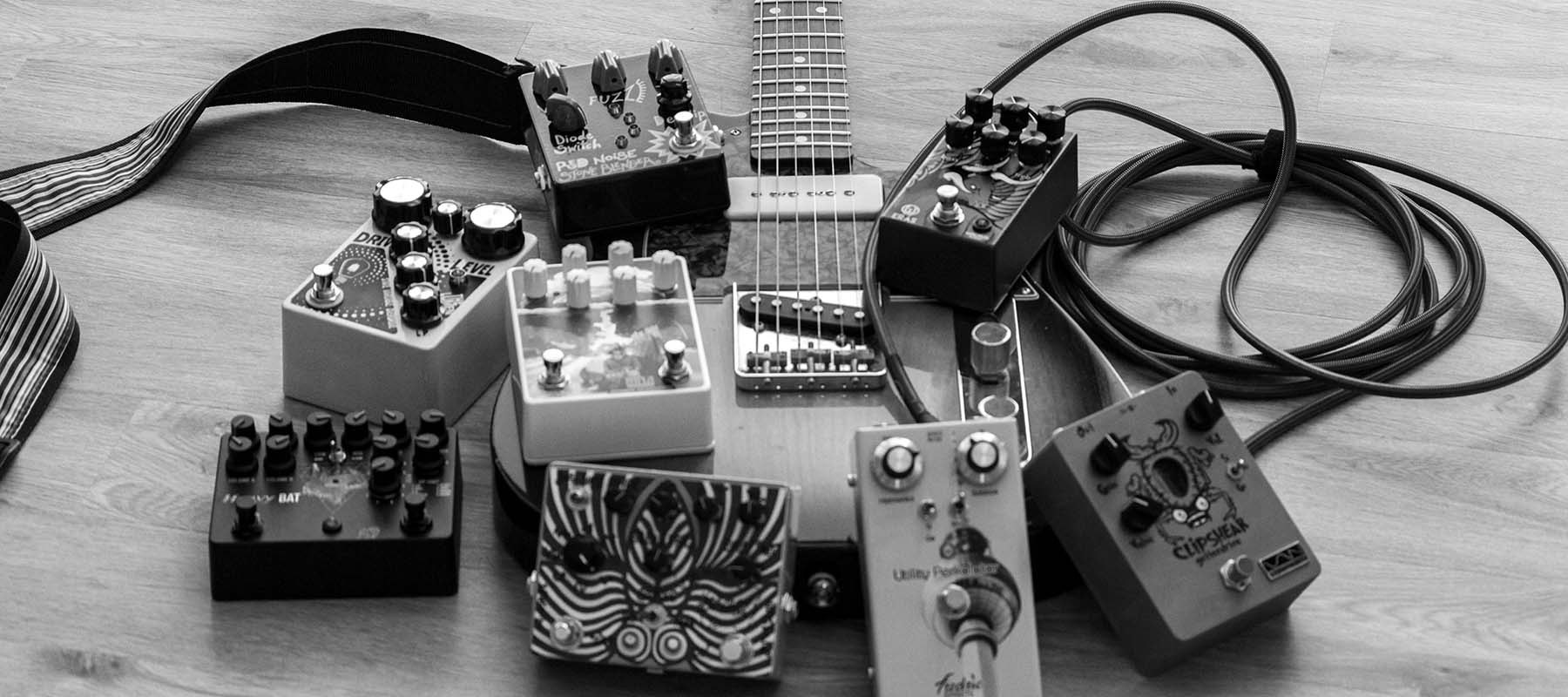
While his vintage guitars and Marshall amplifiers established the foundation of his tone, Frusciante's pedalboard allowed him to move between Funk, Alternative Rock and atmospheric experimentation.
By the 2003 Slane Castle performance, his setup had expanded considerably, incorporating multiple Distortion pedals, Delays, Modulation effects and filters. There are too many to cover in full, but several stand out.

BOSS CE-1 Chorus Ensemble. Credit: Clingan Guitar Tone / Reverb
If there's one pedal that truly defines John Frusciante's guitar tone, it's the BOSS CE-1 Chorus Ensemble.
Originally released in 1976, the CE-1 was BOSS's first standalone effects pedal, offering rich analogue chorus and vibrato alongside a distinctive preamp section. For Frusciante, however, its importance went far beyond chorus.
Dave Lee explains that the CE-1 was essential to the entire amplifier setup, using its stereo outputs to split the signal between the Major and Silver Jubilee. More importantly, its preamp was responsible for much of Frusciante's characteristic clean sound.
Lee would dial in the CE-1's Level control until the signal began to break up slightly under aggressive playing, producing the bright, punchy, almost overdriven clean tone heard throughout his live performances. This is one of the biggest secrets behind Frusciante's sound. What appears to be a conventional clean Stratocaster tone is actually coloured and pushed by the CE-1's preamp before it reaches the amplifiers.
Lee considered the CE-1 one of the three most important elements of Frusciante's sound, alongside his playing and pickups.
[product=fredric-effects-accomplished-badger-germanium-preamp]
Can't stretch to an original CE-1 Chorus Ensemble? This dual-stage preamp/boost is a characterful signal juicer when placed in front of your (probably Marshall) amp. It has a weighty feel to the clean boost and a raucous, spitty granularity to the germanium boost. When combined, you can achieve some seriously heavyweight yet tonally transparent sounds.
[/product]
[product=kink-guitar-pedals-smashed-kraken]
The Kink Guitar Pedals Smashed Kraken is a BBD (bucket-brigade delay) chorus based on the Boss CE-2. The gorgeous BBD character is really organic, lush and sweet sounding, and the Blend control adds an extra level of versatility, allowing you to mix in some of your original signal.
[/product]
The BOSS DS-2 is another essential part of Frusciante's sound. While his amplifiers provide the clean foundation, the DS-2 delivers the aggressive, mid-heavy distortion associated with his explosive lead playing.
Its Turbo II mode adds a pronounced mid-range, helping solos cut through a dense rhythm section.
During this period, multiple DS-2s sat on Frusciante's board, and Lee recalled the Distortion pedals normally running in line – sometimes with three or more switched on at once to push things further over the top. The pedal became a mainstay of his setup, and Lee specifically identified it alongside the CE-1 as crucial to Frusciante's guitar sound.
[product=drunk-beaver-distortion]
Based on the 1978 Made in Japan version of the ever-popular Boss DS-1, this isn't a dead-on DS-2 clone for Frusciante's rig but it will get you well within the ballpark. Bells and whistles include a Mids switch, a switchable Muff gain stage, an 8-way diode selector, and 2 op-amp modes.
[/product]
For Frusciante's distinctive wah sound, the industry-standard Dunlop Cry Baby wasn't his pedal of choice. Instead, he favoured the original Ibanez WH10.
Its unusual vocal sweep and distinctive frequency response made it particularly effective for the expressive, Funk-influenced playing heard throughout the Chili Peppers' catalogue.
The original WH10 also provides a noticeable signal boost when engaged, contributing to the aggressive, almost distorted character of some of his wah-heavy passages.
Unfortunately, the pedal's plastic construction made it notoriously fragile, meaning replacements became increasingly difficult to source. Dave Lee recalls obtaining a replacement through Eddie Van Halen's guitar technician, Matt Bruck.
While the DS-2 provides Frusciante's more focused distortion sound, the Electro-Harmonix Big Muff Pi offers something altogether more aggressive. The Big Muff's thick sustain and heavily compressed fuzz character helped create the enormous lead sounds associated with his live performances.
Two Big Muff pedals were present in the documented Slane Castle setup, alongside his other Distortion and Fuzz effects. These pedals could be combined to create the saturated, sustaining textures that became such an important part of his improvisational playing.
The Big Muff also provides a useful contrast to the relatively clean amplifier setup, allowing Frusciante to move from delicate rhythm guitar to enormous fuzz sounds almost instantaneously.
[products=greenhouse-effects-roots-fuzz,kink-guitar-pedals-scratchie-fuzz,kma-machines-chief-disruptor][/products]
Another notable addition to Frusciante's pedalboard was the ZVEX Fuzz Factory.
Unlike a conventional Fuzz pedal, the Fuzz Factory is capable of producing unstable, oscillating and almost synthesiser-like sounds. Its interactive controls allow the user to manipulate the pedal's response, creating everything from conventional fuzz to unpredictable feedback and squealing textures.
A pair of Fuzz Factory pedals were visible in the Slane Castle setup. Although the exact settings used throughout the concert aren't definitively documented, the pedal was an established part of Frusciante's experimental live effects arsenal during this period.
[products=hungry-robot-the-collective,whimsy-machines-the-great-fantabulizing-whatsitdo,fredric-effects-verzerrer][/products]
During the By the Way era, Frusciante was becoming increasingly experimental with his use of delay and looping. The Line 6 DL4 gave him access to multiple delay sounds alongside a powerful looping function, allowing him to build layered guitar textures during live performances.
A particularly memorable example is "Venice Queen" live at Slane Castle. Frusciante used looping to build the song's atmospheric introduction before transitioning to acoustic guitar later in the performance. The DL4 helped him create arrangements that extended beyond what a single guitarist could ordinarily reproduce live.

The purple Line 6 FM4 was another important addition to Frusciante's effects collection. Offering a range of synthesiser-inspired filters, envelope effects and unusual modulation sounds, the FM4 allowed him to introduce electronic textures into his guitar playing.
The FM4 was used for the unusual filtered guitar textures heard during "Throw Away Your Television", demonstrating Frusciante's willingness to experiment beyond conventional rock guitar sounds.
Known for its distinctive analogue flanging, this pedal creates sweeping, swirling textures that can range from subtle movement to dramatic psychedelic effects.
At Slane Castle, Frusciante used the Electric Mistress during the bridge of "Can't Stop", adding a noticeably different texture to the song's otherwise direct, percussive guitar sound. It's a perfect example of how he used individual effects to highlight specific musical moments rather than leaving everything switched on throughout a performance.
Despite the enormous pedalboard seen during the 2003 tour, recreating Frusciante's core sound doesn't require collecting every piece of equipment he owned. The most important ingredients are surprisingly straightforward and relatively inexpensive to obtain.
Let's break down the fundamentals of achieving this tone on a budget.
If you have to choose a single guitar to chase the John Frusciante tone, it has to be a Stratocaster. If you're on a budget, check out Fender's Player or Standard series, or something from the Squier Classic Vibe series.
Any Strat loaded with three single coils will get you in the ballpark, more so if it has a '60s vibe, as Frusciante preferred early-'60s Strats.
Frusciante always preferred vintage Marshall amps. The Marshall Major was perfect for him because its 200W output let him run it insanely loud without breakup, but for most players that obviously isn't a realistic option.
Luckily, you can get in the same ballpark with any amp that has a great clean channel, as the drive tones largely come from pedals.
A British-style amp is a natural starting point, so explore the Marshall DSL range or the newer Origin line, which offers valve amps at a wallet-friendly price.
If you have a bit more to spend, grab yourself the Marshall Studio Jubilee, a modern 20W head or combo based on the Silver Jubilee. It doesn't have the headroom of the big one, but it has similar mojo and a fantastic clean channel!
If you had to distil Frusciante's core tone into two pedals, it would be the BOSS DS-2 and the CE-1. Both are non-negotiable in this tone-chasing experiment, though a clean original CE-1 now commands serious money.
One solid alternative to the DS-2 is the Drunk Beaver Distortion. While it's based on a 1978 DS-1, it has a number of mods that get you closer to that DS-2 sound, plus a switchable Muff gain stage for those Frusciante fuzz moments!
The CE-1's main role was as a preamp to push the amps a little harder, so you can replicate that with a good preamp or boost. Check out the Fredric Effects Accomplished Badger MkII Preamp, which pairs a 4558 op-amp stage with a NOS germanium transistor for a wonderfully transparent signal boost which adds a kick to your clean tone and then layers on character and grit as you wind it up. It has plenty of headroom, and enough punch to drive your amp's input.

Lead image credit: Raph_PH / Flickr

The guitars, amps and effects behind Iron Maiden's Somewhere in Time (1986) – from the custom Jackson superstrat to the Gallien-Krueger 250ML.

Take a deep dive into Josh Homme's guitar gear and tone on Queens of the Stone Age's 2002 pocket rocket of a release, Songs for the Deaf.

Sleep Token IV's full guitar rig breakdown, including the tuning he'd prefer to keep under wraps...


